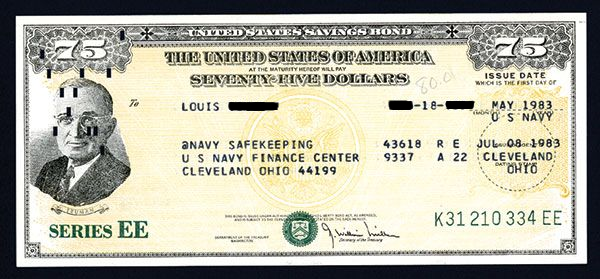
A Series I savings bond bought this month earns 4.26 percent for its first six months. But that headline number is really two numbers wearing one coat: a 0.90 percent fixed rate you keep for the bond’s entire 30-year life, and an inflation adjustment that resets every six months. Savers who understand which part is which make better decisions than savers who chase the combined figure, because one of those parts is permanent and the other is weather.
The Treasury set the current rates on May 1, and they apply to I bonds issued from May 2026 through October 2026. Here is how the two-part machinery actually works, what happens to your rate after the first six months, and the rules on buying and cashing out that catch people by surprise.
Part one: the fixed rate, the part you lock forever
Every I bond carries a fixed rate assigned at purchase, and it never changes for that bond. Buy during a window when the fixed rate is 0.90 percent, as it is now, and your bond earns that 0.90 percent above inflation for up to 30 years, regardless of what the Treasury announces later. Buy during a window when the fixed rate is zero, as it was for stretches of the 2010s and early 2020s, and that bond rides inflation alone forever.
This is why longtime I bond watchers care far more about the fixed rate than the headline. The fixed rate is the only part of the deal that distinguishes a bond bought this month from one bought in some other window; it is, in effect, your permanent real return. The Treasury announces a new fixed rate for new purchases every May 1 and November 1, as explained on the TreasuryDirect rates page, but existing bonds keep the fixed rate they were born with.
Part two: the inflation rate, the part that resets
The second component tracks the Consumer Price Index for all Urban Consumers. Twice a year, the Treasury measures six months of inflation and sets a semiannual inflation rate; the current one is 1.67 percent, which annualizes to about 3.34 percent. Every I bond in existence, whatever its vintage, picks up each new inflation rate in turn, applied on its own six-month schedule counted from its issue month. A bond issued in June gets the current inflation component through November, then switches to the rate announced November 1, and so on for its whole life.
The two parts snap together with a published formula: the composite rate equals the fixed rate, plus twice the semiannual inflation rate, plus the product of the two. Run today’s numbers, 0.90 percent fixed and 1.67 percent semiannual inflation, and you get the advertised 4.26 percent. The formula’s practical meaning is simpler than its algebra: your money grows with measured inflation, plus your permanent fixed margin on top. And if prices ever fall outright, the composite rate has a floor of zero, so a bond’s value never declines.
What your rate does after the first six months
Here is where buyers most often misread the deal. The 4.26 percent is guaranteed only for your first six months. After that, your bond keeps its 0.90 percent fixed rate and takes on whatever inflation components the Treasury announces next, higher if inflation runs hotter, lower if it cools. Nobody, including the Treasury, knows what an I bond bought today will earn in its third year. What you do know is the structure: measured inflation plus 0.90 percent, for as long as you hold it, up to 30 years.
The rules on buying, and the lockup on leaving
I bonds are sold at face value through TreasuryDirect, the Treasury’s own site, with an electronic minimum of $25 and a limit of $10,000 per person per calendar year. A married couple can therefore put away $20,000 a year, and gifts to children count against the child’s limit, not yours. TreasuryDirect is now effectively the only door in; the old option to buy paper I bonds with a federal tax refund was discontinued as of January 1, 2025.
The exit rules are the real fine print. You cannot cash an I bond at all during its first 12 months, so this is not emergency-fund money for the coming year. Redeem any time between one and five years and you forfeit the last three months of interest as a penalty. Hold five years or more and you keep everything. The penalty math is gentler than it sounds in a moderate-rate environment, but it argues for treating I bonds as money you will not touch for several years.
The tax treatment is a quiet bonus
Interest on I bonds is exempt from state and local income tax, a meaningful edge over bank CDs for savers in high-tax states. Federal tax is owed, but not until you redeem the bond or it matures, whichever comes first, so the interest compounds for years untaxed unless you elect to report it annually. And interest used to pay qualified higher education expenses can be excluded from federal tax entirely for filers under the program’s income limits, a niche but valuable feature for families saving toward tuition.
Who they fit, and who should pass
I bonds suit money with a horizon past one year that you want protected from inflation with zero credit risk: the deeper layers of an emergency fund, savings for a goal several years out, the conservative slice of a retirement plan outside tax-advantaged accounts. They fit poorly for money you may need within 12 months, and the $10,000 annual cap keeps them from being a whole strategy on their own. The honest pitch is modest: a government-guaranteed promise that your savings will beat inflation by 0.90 percent a year, with the paperwork of one website account. For a certain kind of saver, that is exactly the promise worth locking in.

Leave a Reply